
When the Machine Eats the Tramp
Part Four About AI

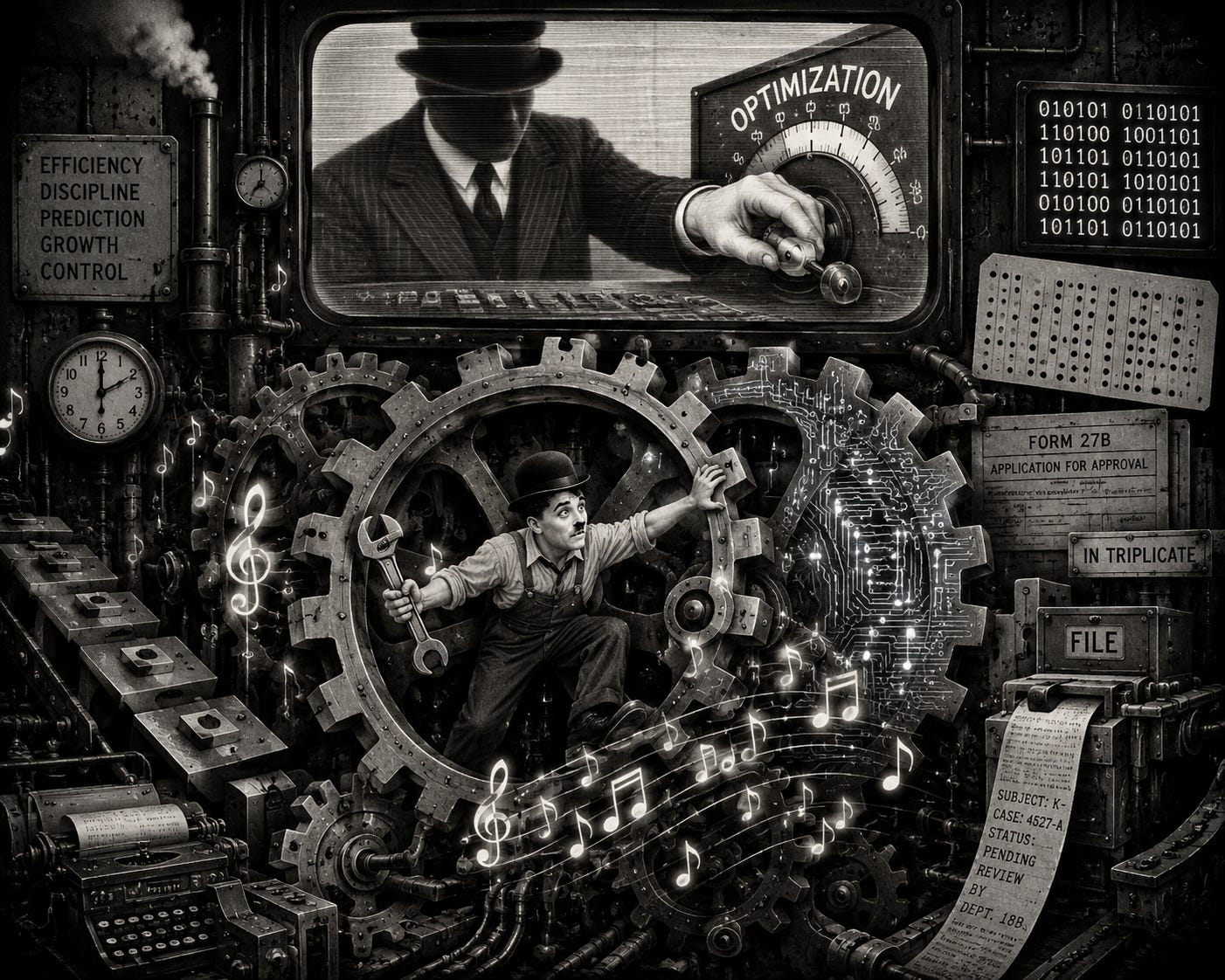
I have yet to read a single piece in the popular press that shows why our cultural inheritance — the past — can be such a powerful framework for thinking about our AI present.
The strange thing is that the framework was sitting in my own family the whole time, and I’m only now seeing it. Ninety years ago, my father, David Raksin, scored Charlie Chaplin’s Modern Times — a film whose argument was that machines are, literally, things that eat people.
In the film’s famous assembly line scene, for example, Chaplin’s Little Tramp is tasked with tightening two bolts on a never ending line of parts. The factory owner monitors everything through a giant screen. But when the boss wants more profit, he doesn’t ask the workers. He simply turns a dial to speed up the belt.
From Alexis De Tocqueville through Hannah Arendt, writers have warned us that modernity erodes agency--not through coercion but through endless choices about what to consume, and fewer and fewer choices about how we live.
But if I had to single out two thinkers whose “old” work can best help us live-ponder AI, they would be these.
Max Weber. The German sociologist told our modern story, our move from thinking based on “that’s how we’ve always done it” (tradition) or the spirits demanded (religion) to behavior based on calculated efficiency and logic. Bureaucracy can be a good thing, Weber wrote, but also dangerous because once massive systems of bureaucracy and capitalism are established, they can take on a life of their own. They strip away human individuality, creativity, and spiritual meaning, replacing them with cold, calculated logic. They stop being tools we use and start becoming the environment we’re forced to live in.
In his famous metaphor “The Cage” (or Stahlhartes Gehäuse in his original German, meaning a “shell as hard as steel”), Weber warned that in the cage you aren’t an individual with unique human nuances; you are a line item, a metric, or a cog in a machine. You don’t follow the rules because they make moral sense; you follow them because it’s the protocol.
Franz Kafka. In novels like The Trial and The Castle, Kafka captures the metaphorical iron cage of paperwork. He depicts ordinary people hopelessly lost in an absolute labyrinth of faceless clerks, endless forms, and absurd, incomprehensible regulations. When you are caught in Kafka’s version of the cage, the paperwork becomes more real than the person. You can’t argue with the system because there is no single person in charge—just an infinite loop of forms to fill out and offices to visit. Kafka felt he was being judged by rules he didn’t know and by people he couldn’t see. He died in 1924, but I sense a similar vertigo today.
All of this can sound like a verdict: that modernity, and now AI, simply close the cage around us. But to stop there would be to miss the deeper point — that modernity can be suffocating and thrilling at once.
Chaplin, Weber, and Kafka are often summoned as prophets of dehumanization. But none was simply nihilistic. Chaplin found comedy in the body’s refusal to become a machine. Weber saw bureaucracy not only as an iron cage but as a disciplined achievement that could make public life more predictable and less arbitrary. Kafka, bleak as he was, understood that modern systems are often funniest when they are most terrifying: their authority depends on making nonsense sound official. Each helps us see AI without surrendering to panic. The machine may be powerful. The file may be endless. The system may speak in a voice no one can locate. But human beings still laugh, judge, improvise, and ask who is responsible.
My father was eighteen when he set that assembly line to music — finding melody in the very machine that was eating the Tramp alive. That is the example to carry into the age of AI: not the panic of the cage, but the human refusal, even now, to stop laughing, judging, improvising, and asking who is responsible.
We must never forget that being human means we need one another to feel belonging and connection. Not just code and logic but emotion and feeling LOVE. I’m excited to see what comes next “I think”.😄
Chaplin gave the machine a body, Kafka gave it paperwork, and now AI gives it a voice. The trick is remembering that just because it talks like an authority doesn’t mean it is one.